Hantavirus-safe cleanup
Hantavirus Cleanup San Luis Obispo, CA
Hantavirus cleanup San Luis Obispo, CA is the job you don't do yourself: deer-mouse droppings in a shed, garage, or crawl space near SLO's open-space edges, handled with ventilated, wet-method, PPE-grade protocol. Never sweep or vacuum droppings — call (805) 475-0516 or book an inspection and let a professional handle it.
- CDC/CDPH-protocol methods, every time
- N95/P100 respirators + wet disinfection
- Full-area disinfection & sealed disposal
When it applies
Do You Need Hantavirus Cleanup San Luis Obispo, CA?
You need it when deer-mouse droppings, urine, or nesting turn up in an enclosed space — a shed, garage, storage room, crawl space, or seasonal cabin near Laguna Lake, Prefumo Canyon, or the Irish Hills. If the droppings are fresh and the space is dusty and enclosed, that's exactly the exposure scenario the protocol exists for.
Where it applies
Enclosed spaces with deer-mouse activity: sheds and detached garages on wildland-edge properties, crawl spaces, storage rooms, and cabins or RVs that sat closed for months. Dust plus droppings plus still air is the combination that matters.
What it isn't
A few old droppings in a ventilated garage or on an open patio isn't an emergency — but it still gets the wet method, not a broom. The protocol scales: same steps, smaller job. When in doubt, treat it as real and call.
The honest local picture
CDPH's county exposure map, updated May 2026, shows zero reported Sin Nombre virus exposures in San Luis Obispo County. This is precaution, not panic — but precaution done properly, because the one exposure you prevent is the only one that counts. About the deer mouse.
Stated plainly
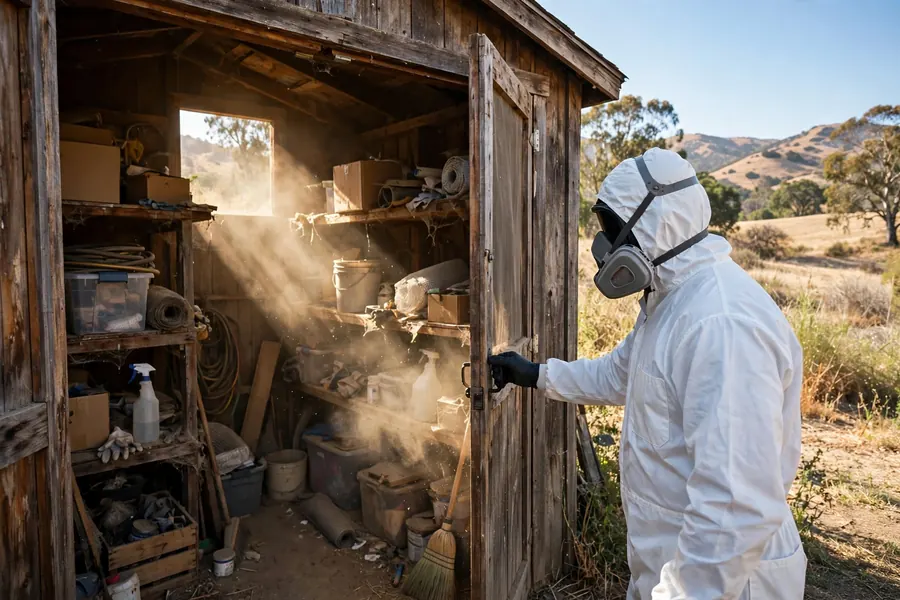
The SLO Risk Picture — No Hype, No Downplaying
Deer mice are the only California rodent known to carry Sin Nombre virus — and CDPH's May 2026 map shows zero reported exposures in San Luis Obispo County. Rare statewide, severe when it occurs: hantavirus pulmonary syndrome kills roughly one in three people who develop it. That's the whole honest picture.
What HPS is
Hantavirus pulmonary syndrome is a severe respiratory illness that develops one to eight weeks after exposure. Early symptoms mimic the flu — fever, muscle aches, fatigue — then breathing becomes difficult as the lungs fill with fluid. There is no specific cure; treatment is supportive hospital care.
How exposure happens
By breathing dust contaminated with deer-mouse droppings, urine, or nesting material — most often when cleaning an enclosed space that's been closed up. Less commonly through bites or touching contaminated material then touching the face. Every route starts with disturbing dry droppings.
Why protocol anyway
Because low-probability, high-consequence risks are exactly what protocols are for. The wet method, ventilation, and respirators cost little and eliminate the exposure route entirely. We follow the full protocol on every deer-mouse job — theoretical risk or not.
Our position: we will never claim a local hantavirus case to sell a cleanup — there are none on record in this county, and we'll say so every time. We will also never cut corners on the method, because the protocol exists for the exposure nobody saw coming.
The carrier
Know the Carrier: The Deer Mouse
Direct answer: the deer mouse (Peromyscus maniculatus) is the only California rodent known to carry Sin Nombre virus, the cause of hantavirus pulmonary syndrome. House mice and roof rats do not carry it — so identifying which mouse you are dealing with decides whether the full hantavirus protocol applies.
Telling them apart is straightforward once you know the marks. The deer mouse is bi-colored: grayish-brown back, clean white belly and feet, with oversized ears and eyes that give it an almost cute look. The house mouse is uniform gray-brown all over, smaller-eared, and the one you find in kitchens and pantries. Deer mice live at the wildland edge — chaparral, brushy slopes, woodpiles — which in SLO means the Irish Hills, Prefumo Canyon, and the open-space borders around Laguna Lake. A mouse in a shed backing onto open space is a deer-mouse suspect until proven otherwise; a mouse in a downtown pantry almost certainly is not.
How long does the virus survive outside the mouse?
Per CDC, hantaviruses stay viable in the environment for roughly two to three days at normal room temperature — longer in cool, damp, shaded spots, and killed quickly by sunlight. That is why waiting it out is not a strategy: the right move is disinfectant with proper wet contact time, which deactivates the virus on contact rather than on a clock.
PPE checklist: what the protocol requires
| Gear | Spec | Why it matters |
|---|---|---|
| Respirator | N95 or P100, properly fitted | Virus rides on airborne dust — a paint-aisle dust mask does not seal |
| Gloves | Rubber, latex, or nitrile — never bare hands | Blocks contact transmission; removed last, then hands washed |
| Eye protection | Goggles, not glasses | Keeps contaminated dust out of eyes during wet pickup |
| Coveralls | Disposable, full-body | Clothing does not carry contamination back into the house |
We run this exact checklist on every deer-mouse job — theoretical county risk or not. The protocol exists for the exposure nobody saw coming, and the gear costs far less than the alternative.
The critical rule
Why You Never Sweep or Vacuum Droppings
Sweeping and vacuuming launch virus particles into the air you breathe — the single most dangerous thing you can do with rodent droppings. A standard vacuum is worse than a broom: it aerosolizes fine particles and blows them through the exhaust. The safe method is always wet. The CDC’s cleanup guidance says the same: never sweep or vacuum — always wet down first. The same rule applies to nesting material — our rat nest vs mouse nest guide shows how to identify the nest from the droppings and nesting material without disturbing it.
Step 1 — Ventilate
Open doors and windows, then leave the space for at least 30 minutes. Let the air exchange before you go back in — don't stand in the dust cloud deciding what to do.
Step 2 — Gear up
Gloves and an N95 or P100 respirator, minimum. No bare hands, no dust mask from the paint aisle — a properly fitted respirator or nothing.
Step 3 — Wet it down
Soak droppings, urine spots, and nesting material with a 10% bleach solution (1 part bleach to 10 parts water) and let it sit a full five minutes. Wet contact time is what deactivates the virus.
Step 4 — Pick up & bag
Paper towels, not rags — pick everything up, then double-bag the waste in sealed plastic bags. Dead mice get the same treatment: gloves, bag, seal. See dead rodent removal.
Step 5 — Disinfect the area
Mop floors and wipe hard surfaces with disinfectant. Wash bedding and clothing in hot water with detergent. Carpets and upholstery get disinfectant treatment, not just vacuuming.
Step 6 — Wash up
Gloves off last, hands washed thoroughly with soap and water. Respirator disposed of or cleaned per manufacturer guidance. Then — and only then — the job is done.
How we do it
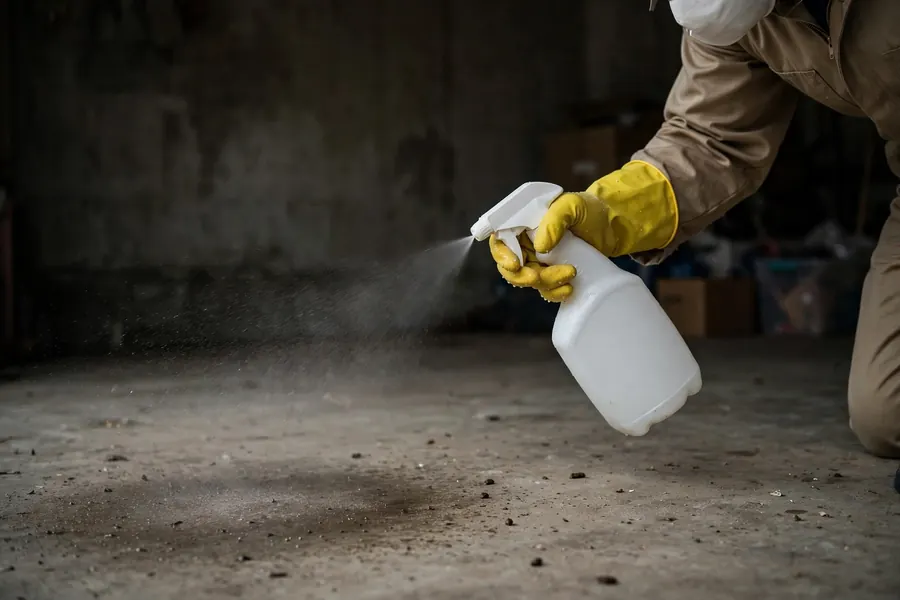
Our Professional Cleanup Process
We bring the protocol plus the equipment: respirators and coveralls, HEPA-filtered vacuums rated for the job, full-area disinfection, and sealed waste disposal — then we find how the mice got in, because cleanup without exclusion is a recurring appointment. It's the same pro-grade standard behind our rodent control in San Luis Obispo — no shortcuts, no guesswork.
-
Assess & ventilate
We evaluate the contamination level, identify the species from droppings and location, and ventilate the space before work begins. Heavy contamination in a sealed crawl space is a different job from a dusty shelf — the plan scales to the reality.
-
PPE & wet disinfection
Full protective gear on, then the wet method across every contaminated surface: 10% bleach solution, five-minute soak, no dry disturbance at any point. Nesting material and droppings get picked up by hand, never swept.
-
HEPA removal & disposal
HEPA-filtered equipment handles what hand pickup can't, and all waste — droppings, nesting, contaminated insulation, PPE — is double-bagged, sealed, and disposed of properly. See attic cleanup for insulation-level jobs.
-
Disinfect, verify & seal
Full-area disinfection, then verification that the space is clean — and an exclusion inspection to find every 1/4-inch entry the mice used. See rodent exclusion.
After the cleanup
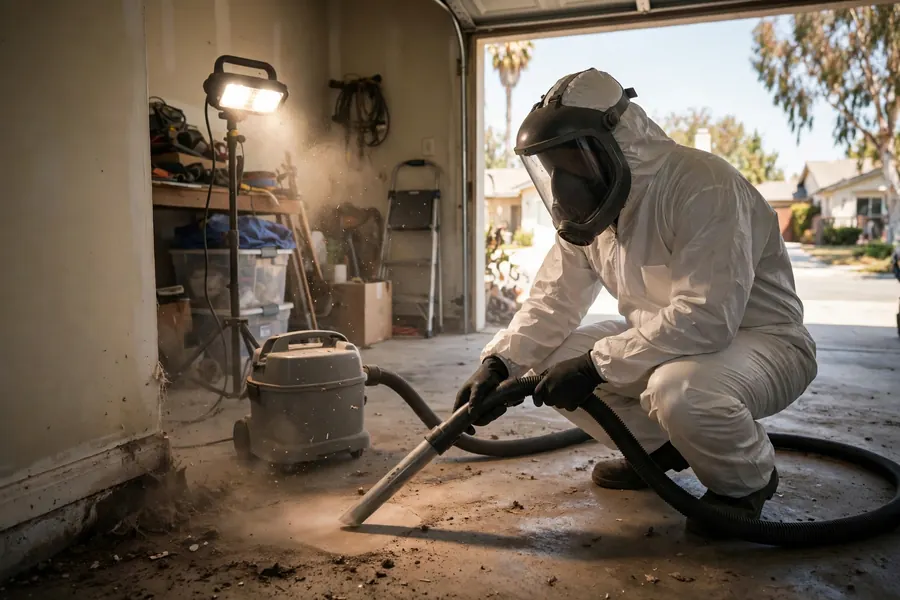
Keep Mice Out After Cleanup
The mice that left those droppings got in through gaps you can close. Post-cleanup exclusion is what turns a one-time service into a solved problem — 1/4-inch sealing, secured outbuildings, and the attractants removed.
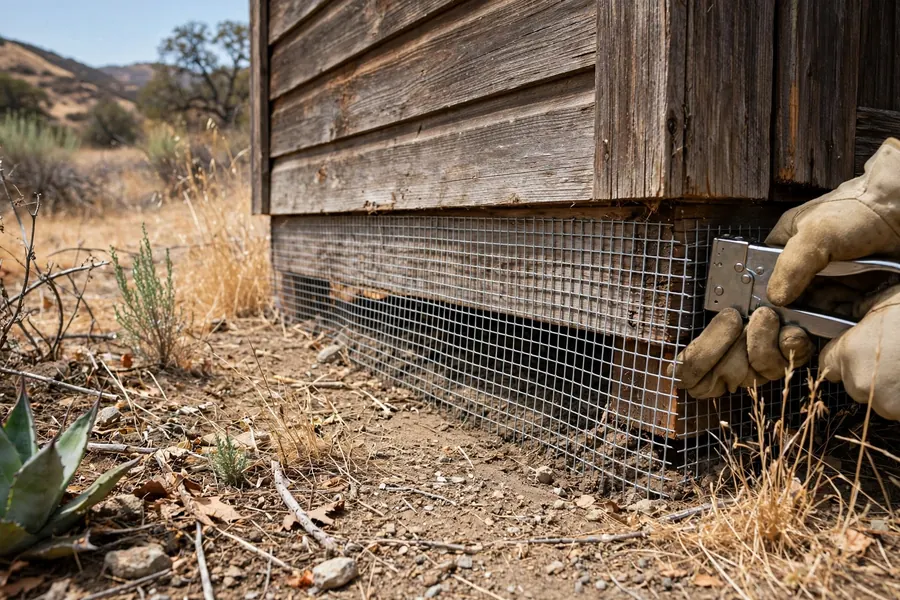
Seal the quarter inch
Every gap over 1/4 inch in sheds, garages, and crawl spaces gets galvanized mesh, steel wool, or sheet metal. Sweeps on shed and garage doors. Screens on every vent. Our rodent exclusion service covers all of it.
Lock down the attractants
Birdseed, grass seed, pet food, and chicken feed in sealed metal cans — never bags. Fallen fruit picked up. A sealed outbuilding with no food is one deer mice walk past.
Hold the wildland edge
Vegetation gap between open space and your buildings, woodpiles moved away from structures, ground cover trimmed at the chaparral edge. For whole-property protection, see residential rodent control and our deer mouse control page.
Good to know
Hantavirus Cleanup Questions, Answered
Hantavirus pulmonary syndrome (HPS) is a severe respiratory illness caused by Sin Nombre virus, carried by deer mice — the only California rodent known to carry it. People get it by breathing dust contaminated with deer-mouse droppings, urine, or nesting material, which is why enclosed, dusty spaces are the exposure scenario and why droppings must never be swept or vacuumed.
No reported exposures. CDPH's county exposure map, updated May 2026, shows zero reported Sin Nombre virus exposures in San Luis Obispo County. The risk here is precautionary — but the cleanup protocol is followed the same way regardless.
Never sweep or vacuum rodent droppings, urine, or nesting material — dry methods launch virus particles into the air you breathe. The safe method is always wet: ventilate, wear gloves and an N95 mask, soak everything with disinfectant, pick it up, and double-bag the waste.
One part household bleach to ten parts water, applied generously over droppings, urine, and nesting material with a full five-minute soak before anything is touched. Commercial disinfectants labeled for the purpose work too — the key is wet contact time, not the brand.
At least 30 minutes: open doors and windows, then leave the space while it airs out. Don't start cleanup while the air is still settling — ventilation first, PPE on, then the wet method.
Gloves and an N95 or P100 respirator at minimum, for any droppings cleanup. Professionals add coveralls and eye protection for heavy contamination, plus HEPA-filtered equipment and sealed waste disposal.
Cleanup without exclusion is a recurring appointment: seal every 1/4-inch gap with steel mesh and sheet metal, fit sweeps on shed and garage doors, store seed and pet food in sealed metal cans, and keep a vegetation gap at the wildland edge. Our rodent exclusion service handles the full job.
Look at the belly and feet. A deer mouse is bi-colored — grayish-brown back, clean white belly and feet — with large ears and eyes. A house mouse is uniform gray-brown all over with smaller ears. Deer mice also live at the wildland edge (brushy slopes, woodpiles, sheds backing onto open space); house mice live in kitchens and pantries.
Per CDC, hantaviruses stay viable roughly two to three days at normal room temperature — longer in cool, damp spots, killed quickly by sunlight. Waiting it out is not a strategy; disinfectant with a full five-minute wet contact time deactivates the virus on contact.
Don't Breathe That Dust. Call a Pro.
Deer-mouse droppings need the wet protocol, respirators, and sealed disposal — not a broom. Call now or book an inspection and we'll handle it safely. Every job is backed by homeowners trust — thorough inspection, honest quote, sealed for good.
(805) 475-0516