Identification guide
Rat Nest vs Mouse Nest: How to Tell What's in Your Attic
Rat nest vs mouse nest identification decides everything about your next step — trap size, trap placement, and which entries to seal. The good news: you don't need to see the animal. Droppings, gnaw marks, and nesting habits tell the story, and this guide walks you through reading the evidence like a pro.
- Droppings: the fastest ID
- Gnaw marks: 1/6 in vs 1/12 in
- Nesting habits differ by species
Droppings
Droppings Don't Lie
Direct answer: measure the droppings. Mouse droppings are about 1/4 inch, rod-shaped; roof rat droppings about 1/2 inch, spindle-shaped; Norway rat droppings about 3/4 inch, capsule-shaped. Size alone identifies the species in most cases.
House mouse — 1/4 inch
Small, rod-shaped pellets with pointed ends, scattered along baseboards and under sinks. Many droppings in a small area: mice defecate constantly as they travel.
Roof rat — 1/2 inch
Spindle-shaped — pointed at both ends, thicker in the middle. Found in attics, along rafters, near citrus trees. The SLO attic classic.
Norway rat — 3/4 inch
Blunt, capsule-shaped, larger. Found along foundations, in crawl spaces, near burrows and garbage areas. Ground-level evidence.
Fresh vs. old
Fresh droppings are dark and soft; old ones gray and crumbly. Fresh means current activity — the distinction that decides whether you trap now or monitor.
Marks
Gnaw Marks and Rub Marks
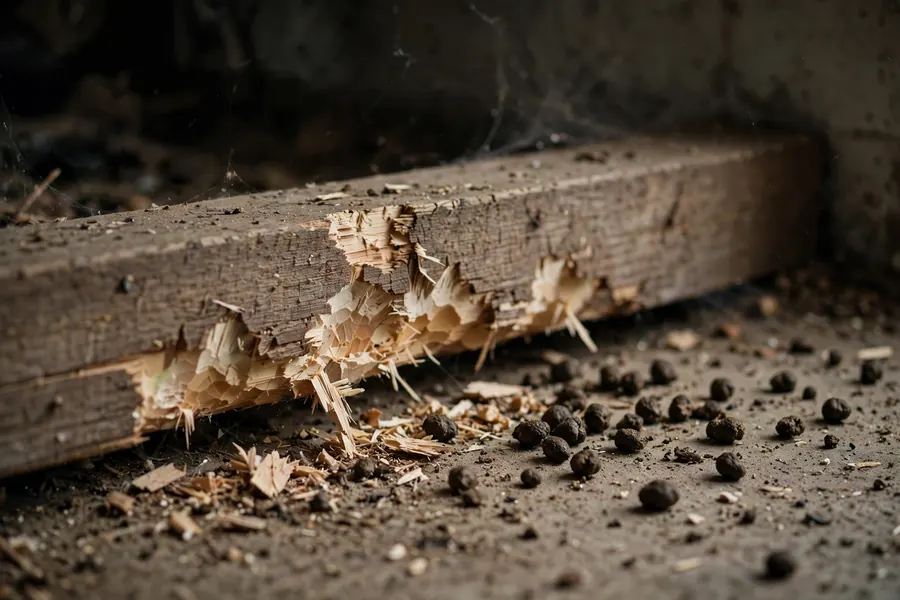
Direct answer: rat tooth marks are about 1/6 inch wide; mouse marks about 1/12 inch — fine and scratchy. Dark smudge marks (rub marks) on beams and pipes mark active rat runways.
Rat gnaw — 1/6 inch
Broad, distinct paired tooth marks on wood, plastic, even soft metals. Rats gnaw constantly — their teeth never stop growing — so marks are bold and deep.
Mouse gnaw — 1/12 inch
Fine, scratchy marks — much subtler. Look on pantry shelving, baseboards, and food packaging. If you need magnification to see it, it's mice.
Rub marks
Oily smudges along beams, rafters, pipes, and wall edges where rats' fur repeatedly contacts the surface. Rub marks mean a runway in active use — prime trap real estate.
Burrows vs. nests
Norway rats burrow outdoors along foundations (entrance, nest, and escape holes). Roof rats and mice nest indoors — attics, wall voids, insulation. Burrows outside plus droppings inside often means Norway rats commuting.
Habits
Nesting Habits by Species
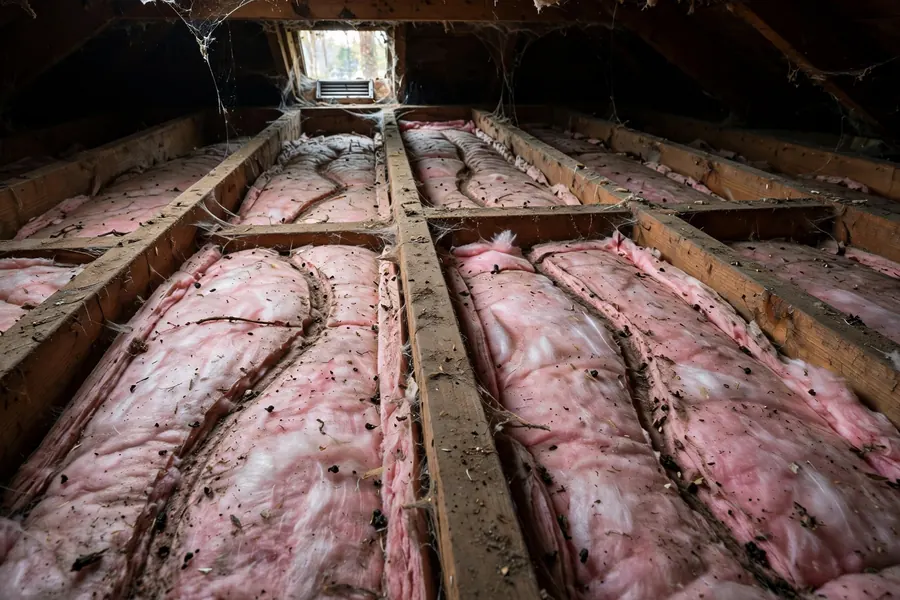
Direct answer: roof rats nest up high — attics, trees, dense vegetation — shredding insulation; house mice nest in small hidden voids close to food; Norway rats burrow at ground level.
Roof rat nests
Shredded insulation, paper, and fabric in attics, wall voids, and dense vegetation. The attic shredder is almost always a roof rat in coastal California — see our roof rat control guide. In SLO backyards the giveaway is usually the citrus: hollowed-out orange rinds still hanging on the tree, pulp eaten clean out — that's the UC Master Gardeners of SLO County's classic field-rat sign, and we see it on avocados too. Hollowed rinds outside plus shredded insulation in the attic means field rats, not mice.
House mouse nests
Small, compact nests of finely shredded material tucked into wall voids, behind appliances, inside stored boxes. Modest and hidden — mice nest near food, not far from it.
Norway rat nests
Burrows along foundations, under woodpiles and garbage areas, in overgrown ground cover. Indoors they take basements and ground floors rather than attics.
Deer mouse nests
Outdoor-oriented — sheds, garages, woodpiles — and the hantavirus carriers, so droppings near their nests get the full CDC-protocol cleanup. Our hantavirus cleanup protocol covers it.
At a glance
Nest ID at a Glance
Direct answer: match what you found to the row below. Droppings size is the fastest column; nest location is the tiebreaker when droppings are ambiguous.
| Species | Droppings | Where it nests | Nest materials | Dead giveaway |
|---|---|---|---|---|
| House mouse | ⅛–¼ in, thin, pointed ends | Wall voids, behind appliances, stored boxes — always near food | Finely shredded paper and fibrous material (UC IPM) | Tiny compact nests; droppings scattered in large numbers along runways |
| Roof rat | ½ in, spindle-shaped, pointed both ends | Attics, rafters, wall tops; outdoors in ivy, palm crowns, dense shrubs | Shredded insulation, leaves, twigs, paper | Hollowed citrus rinds still on the tree; dark grease smudges on beams |
| Norway rat | ¾ in, capsule-shaped, blunt ends | Burrows along foundations; indoors takes basements and ground floors | Burrow bedding of grass, paper, and debris | Burrow entrances with smooth packed runways; droppings clustered near burrows |
| Deer mouse | ¼ in, pointed — like a house mouse | Sheds, garages, woodpiles — outdoor-oriented | Grass, plant fibers, shredded bark | Found away from the house core; treat droppings with CDC hantavirus protocol |
Not every sign carries equal weight. This is how we rank the evidence during an inspection — field guidance, not a statistic:
Local
What We Find in SLO Nests
Direct answer: in San Luis Obispo, most indoor nests are roof rats — and the outdoor evidence usually points straight at them before we ever open the attic hatch.
Roof rats are principally an outdoor species in California — they nest in Algerian ivy, Himalayan blackberry, and dense thickets, getting food and cover without ever needing your house. In SLO that translates to ivy-covered fences, palm crowns, and bougainvillea walls — the landscaping half the town has. UC IPM specifically names ivy, star jasmine, and honeysuckle as hidden ladders and nest sites, and a UC Berkeley public-health biologist calls vertical ivy growth along fences excellent avenues for rat movement.
Terrain matters here too. SLO sits at the foot of the Santa Lucia Mountains, so homes on brushy or ivy-covered slopes get rats descending from the vegetation above — and they arrive at the roof first, which is exactly how roof rats work. Creek corridors do the same job horizontally: SLO Creek, Stenner, and Prefumo thread green corridors through town, and CDFA lists stream banks and dense vines as prime black-rat habitat. Downtown (creek plus Higuera food waste), Laguna Lake (reservoir plus Prefumo corridor), and the Cal Poly area (Stenner Creek, eucalyptus groves, hillside slopes) are the neighborhoods where we read these signs most.
Why it matters
Why Correct ID Changes the Strategy
Direct answer: trap size, trap placement, and exclusion targets all depend on species. Guessing wastes weeks; a five-minute ID gets the right plan from day one.
Trap size
Mouse traps for mice, rat traps for rats — a mouse can steal bait from a rat trap without tripping it, and a rat can drag off a mouse trap. Size matters.
Placement
Roof-rat traps go elevated — ledges, beams, rafters. Norway-rat traps go at ground level along walls. Mouse traps go within 10 feet of activity, close to walls.
Exclusion targets
Roof rats mean eaves, vents, and tree-to-roof bridges. Norway rats mean foundation vents and burrows. Mice mean the 1/4-inch gaps everywhere. Our rodent exclusion service targets by species.
When to call a pro
Mixed signs, heavy activity, or uncertainty — that's our daily work. A professional inspection IDs the species in one visit and the plan follows. See mice control and rat control for the species pages.
Good to know
Nest ID Questions, Answered
Take a clear photo next to a coin for scale and compare: mouse (1/8–1/4 in, thin and rod-shaped), roof rat (1/2 in, spindle), Norway rat (3/4 in, capsule). Still unsure? That's exactly what our inspection is for — ID in one visit.
Yes — different zones, sometimes. Roof rats take the high rafters; mice take the eaves and wall tops. Mixed evidence means a dual-species plan: different trap sizes, different placements.
Often. Attic nests point to eave, vent, and roofline entries; wall-void nests point to ground-level gaps and pipe chases; burrows point to foundation issues. The nest is the end of a trail that starts at an entry.
With gloves and disinfectant, small amounts — following CDC guidance: never sweep or vacuum droppings (it aerosolizes viruses). Larger contamination, especially with deer-mouse signs, calls for our hantavirus cleanup protocol.
Usually, yes. Nests in the attic, rafters, or dense vegetation point to roof rats; burrows at the foundation or nests on the ground floor point to Norway rats. The two species can't interbreed and they split the house vertically — roof rats up, Norway rats down. See our roof rat control and Norway rat control pages for the species-specific plans.
No. UC IPM is blunt: "High frequency electronic devices aren't effective." There are documented cases of rodents building nests directly on top of active ultrasonic units — they habituate within days. We tested the claims in detail in do ultrasonic rodent repellers work?
Attic cleanup with contaminated insulation runs $1,500–$8,000+ in California depending on contamination level; exclusion (sealing every entry to the 1/4-inch standard) runs $500–$3,000+. We break down every line item in what rodent exclusion costs, and our rodent exclusion service page covers the process.
Know What's Up There. Then Evict It.
One inspection IDs the species and maps the entries — then the right traps in the right places. Call now or book an inspection.
(805) 475-0516SLO Rodent Control — inspection-first rodent control in San Luis Obispo, CA.