Rat control
Rat Exterminator San Luis Obispo, CA
A rat exterminator San Luis Obispo trusts for roof rats — the climbing specialist raiding citrus trees and nesting in attics. We trap by species, then seal them out for good. California-compliant, no poison reliance. For the full attic-invader playbook, see our roof rat control guide. As a full-service rodent control San Luis Obispo company, we handle inspection, trapping, and exclusion in one coordinated visit.
- Inspection-first — we find every entry point
- Exclusion-first — sealed with steel, not poison
- Local — we know SLO's roof-rat pressure
Signs it's rats
Rat Exterminator San Luis Obispo: Do You Need One?
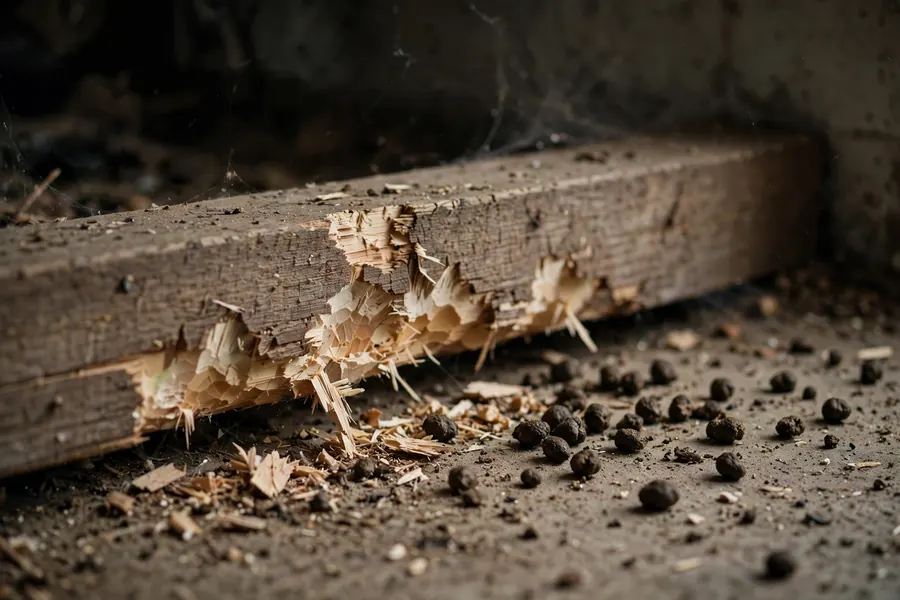
You need a rat exterminator in San Luis Obispo when the evidence points past mice: scratching in the attic at night, droppings bigger than a grain of rice near food, gnaw marks with clear tooth grooves, or citrus hollowed out on the tree. Rats cause more damage than mice — chewed wiring, shredded insulation, contaminated food — so waiting costs more than acting.
Attic scratching at night
The classic roof-rat sign. They favor attics, wall voids, and false ceilings — if the noise is overhead after dark, it's rats until proven otherwise.
Bigger droppings, bigger marks
Roof rat droppings run about 1/2 inch and spindle-shaped; Norway rat about 3/4 inch and capsule-shaped. Gnaw marks show distinct 1/6-inch tooth grooves — far coarser than mouse nibbles. Not sure which rat you're dealing with? Compare the signs in our Norway rat control guide.
Citrus damage
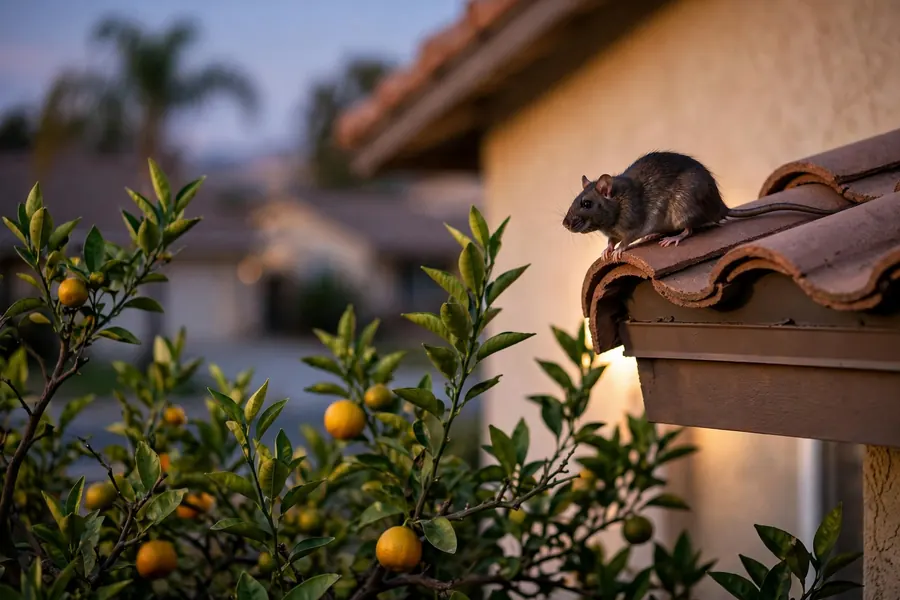
SLO's signature clue: oranges with a small hole and the pulp eaten out, leaving a hollowed rind hanging on the tree. UC Master Gardeners of SLO County call this textbook roof rat damage.
Know your rat
Roof Rats vs. Norway Rats: Which One Is in Your Home?
The species decides everything — where traps go, where the nest is, and which entries to seal. Get it wrong and you trap the wrong places for weeks.
Roof rat (Rattus rattus)
Smaller and sleeker, with a tail longer than its head and body combined. An agile climber that nests aboveground — attics, wall voids, ivy, palm canopies, dense shrubs against the house. This is SLO's rat: the coastal California urban rat, active year-round. Traps go elevated — on ledges, beams, and rooflines.
Norway rat (Rattus norvegicus)
Larger and stockier (7–18 oz), a burrower that nests along foundations, under woodpiles and trash, and in gardens or fields. Indoors it sticks to basements and ground floors rather than attics. Traps go low, along walls and near burrows. Thinking you have mice? See our mice control page.
Two facts that matter on every job: roof rats and Norway rats cannot interbreed (UC IPM) — so you're dealing with one species, not a hybrid. And the CDFA notes roof rats are "found mainly near salt water" and thrive in California's coastal climate — which is exactly why they dominate here while Norway rats stay the minority.
Local reality
Why SLO Is Roof Rat Country
"Rats love avocados and citrus" — that's UC Master Gardeners of SLO County, describing exactly what happens in local backyards every fall. Roof rats are expanding across California's Central Coast, and San Luis Obispo gives them everything they want. (UC IPM’s rat guide covers the same identification markers we use on every inspection.)
Citrus, ivy, palms
Roof rats live in trees as happily as in attics. Citrus and avocado trees feed them; ivy slopes, bougainvillea, and palm canopies house them; overhanging limbs become elevated highways straight to your roofline.
Old homes, new gaps
Downtown's century-old homes have aged fascia gaps at the roofline, original unsealed vents, and raised crawl spaces — a roof rat's dream layout. Even 1970s tracts have tile-roof gaps that rats travel like roads.
Year-round pressure
Roof rats stay active all year in California. The surge SLO homeowners notice from October through January — first rains, cooling nights, ripening fruit — is movement, not new breeding. Late summer and fall is when citrus damage and attic activity peak.
What to do about the yard: prune tree limbs at least 3 feet from the roof (6 feet is better), keep a 2-foot gap between shrubs and the building, remove climbing vines near the house, pick up fallen fruit, and keep garbage lids tight. Habitat work is half the job — a trimmed yard is a less inviting one.
Spot them early
Signs of Roof Rats: What to Look (and Listen) For
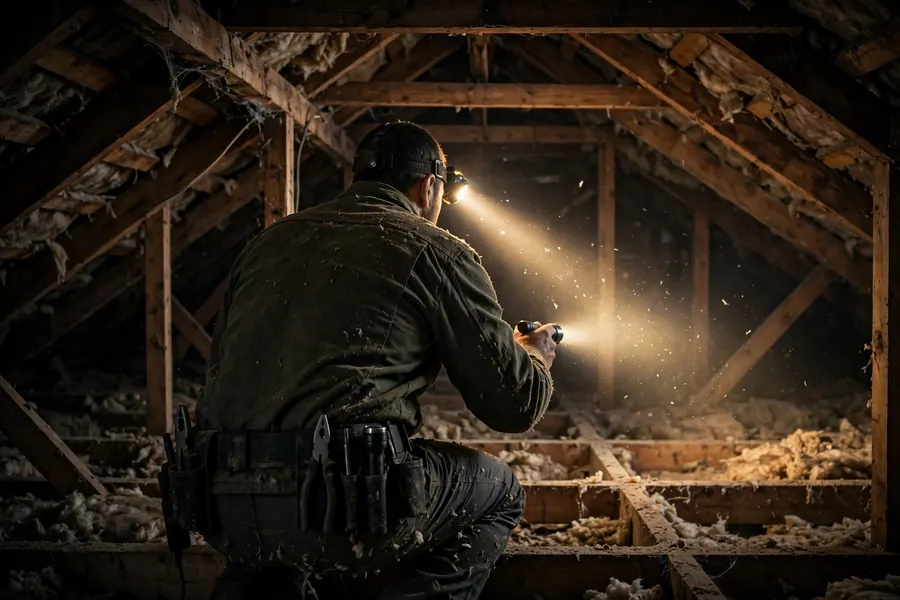
Roof rats are nocturnal — peak activity runs from about half an hour after sunset to half an hour before sunrise (UC IPM). Here's what gives them away, from the attic to the backyard.
Attic sounds at night
Scratching and scurrying above the ceiling — not in the walls. Roof rats run the overhead routes: attics, false ceilings, wall voids near the top. If the noise is overhead after dark, it's roof rats until proven otherwise. Norway rats stay lower — walls, basements, baseboards.
Grease smudges
Dark rub marks along beams, rafters, pipes, and overhead wires. Rats follow the same runways nightly, and their oily fur leaves smudge trails. Fresh smudges mean active routes — that's where traps go.
Hollowed fruit rinds
Oranges with a small hole and the pulp eaten out, rinds left hanging on the tree. Lemons with the rind eaten off entirely. Avocados gnawed on the branch. This is textbook roof rat feeding — they eat like tree squirrels.
Gnawed wiring
Rats gnaw constantly to wear down their teeth — and attic wiring is a favorite. Chewed insulation on electrical wires is a fire hazard, not just a nuisance. If you see it, don't wait. Our guide to rodent damage in SLO homes explains what rats destroy in attics and wall voids — and why the repair bill usually shows up months after the gnawing starts.
Droppings in volume
A single rat produces around 50 droppings a day (WA Dept. of Fish & Wildlife). Roof rat droppings are about 1/2 inch, spindle-shaped with pointed ends — look for them along runways, near food sources, and under attic entry points.
Rats at dusk
Watch overhead utility lines and fence tops at dusk. Roof rats "often seen at night running along overhead utility lines or fence tops" (UC IPM) — if you spot them commuting, you've found their highway.
How we do it
How We Remove Rats — Then Keep Them Out
Rats are neophobic — they avoid new traps and baits for days or even weeks, and roof rats are the worst of all. So we pre-bait before we set, place by species, and finish with exclusion.
-
Inspect & ID
Species confirmation from droppings, marks, and rub marks — smudges on beams and pipes that mark active runways. Roof rat or Norway rat decides the entire plan.
-
Trap by species
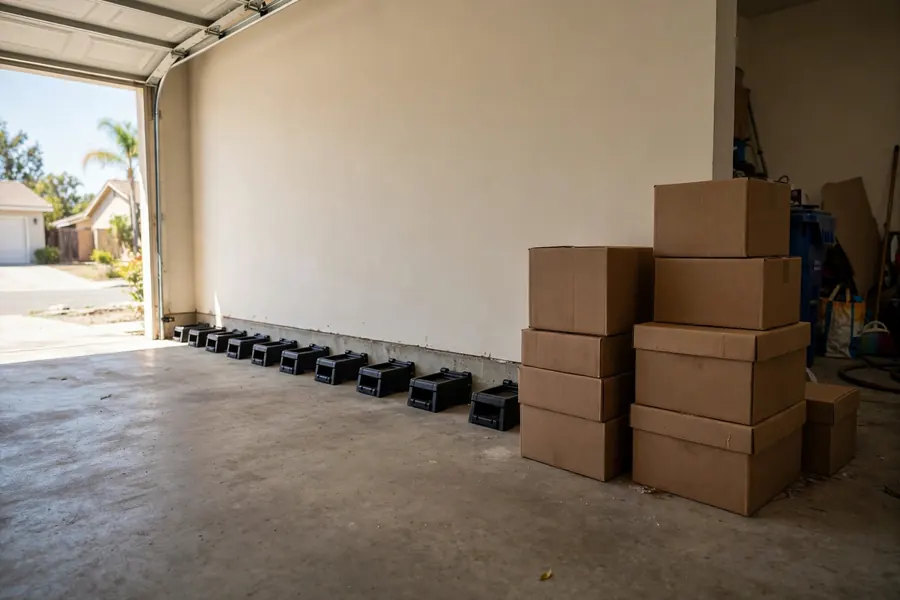
Roof-rat traps go off the ground — ledges, shelves, beams, fence tops — spaced 10–20 feet apart, a dozen or more for heavy infestations. Norway-rat traps go along walls and dark corners near burrows. Baited-but-unset first, until bait is taken reliably.
UC IPM calls snap traps "the safest, most effective, and most economical way to trap rats" — and the pros agree. We use expanded-treadle snap traps (Victor Professional style), nailed to beams or wired to pipes along active runways. Unlike poison, there's no risk of a rat dying inside a wall and creating an odor problem.
Why we pre-bait: rats — especially roof rats — are neophobic. They avoid new objects for days. San Mateo County Vector Control puts it plainly: "Pre-baiting traps is an important step. Rats tend to avoid new objects… After the rats have taken the bait over several days, set the traps." Skip this step and you'll catch nothing for a week. Best roof-rat baits: raisins, prunes, peanut butter, and nutmeats — often better than meat or cat food.
-
Exclude
Every opening over 1/2 inch for rats (1/4 inch keeps mice out too) sealed with galvanized mesh, steel wool, and sheet metal — never foam or caulk alone. UC IPM calls exclusion the most successful, longest-lasting rat strategy there is. See exclusion details.
-
Reduce the habitat
Sanitation and harborage work around the property — the attractants removed, the climbing routes cut — so the next rat wave finds nothing worth staying for.
Know the law
California's Poison Ban: Why We Trap Instead
California has restricted anticoagulant rat poisons statewide — and the rules keep tightening. Here's what that means for your home.
What changed
AB 1788 (2021) banned the four main second-generation poisons statewide. AB 1322 (2024) added diphacinone. AB 2552, the Poison-Free Wildlife Act (signed September 2024), restricted all remaining anticoagulant rodenticides — with penalties up to $25,000 per day per violation. Homeowners can't legally buy these products for home use, and licensed pros can't routinely use them either.
Why it matters
The wildlife toll drove the bans: 88% of tested raptors and 28 of 29 mountain lions showed poison exposure (CDFW). Poisoned rats wander for days as easy prey, spreading toxins up the food chain — owls, hawks, bobcats, and pets included. As one Cal Poly professor put it: with poisoned animals dying across the landscape, "who's gonna manage all of these dead and dying animals?"
What this means for you: the industry has shifted to trapping plus exclusion — which is better anyway. Trapped rats don't die in your walls. There's no secondary poisoning risk to pets or wildlife. And sealed entries keep the next wave out permanently, something poison never did.
Straight numbers
What Rat Control Costs in SLO
Ranges only — every home is different, but here's what the work typically runs in our market.
Red flag: a quote that covers only trapping — no exclusion, no follow-ups, no warranty. If the entries stay open, trapping never ends. Compare line items (inspection, trapping, exclusion materials, follow-ups, written warranty), not just the headline price.
Good to know
Rat Control Questions, Answered
Roof rats are smaller and sleeker, with a tail longer than their head and body combined — agile climbers that nest aboveground in attics, wall voids, trees, and ivy. Norway rats are larger, stockier burrowers that nest along foundations, under woodpiles and trash, and stick to basements and ground floors indoors.
Scratching in the attic at night is the classic roof-rat sign — they favor attics, wall voids, false ceilings, and cabinets. Other signs: droppings near food, 1/6-inch gnaw marks, burrows along foundations, rub marks on beams, and rats running along utility lines or fence tops at dusk.
Roof rats. UC Master Gardeners of SLO County call it textbook damage: oranges with a small hole and the pulp eaten out, leaving a hollowed rind hanging on the tree — or lemons with the rind eaten off entirely. Rats love avocados and citrus.
Usually, yes. Locals say "field rats," but the animal raiding citrus trees and nesting in attics around San Luis Obispo is the roof rat (Rattus rattus) — a climbing species. Knowing the species matters because it changes where traps go.
Plan on several weeks, not a single visit — rats are cautious around new traps and baits, so pre-baiting is part of the job. Most homes are rat-free after two to four follow-ups, then exclusion keeps them out for good.
We don't rely on broadcast poison at all. Our approach is inspection, trapping, and exclusion — California-compliant IPM. Poisoned rats also die inside walls, creating odor and sanitation problems that trapping avoids.
California law. AB 2552 (2024) restricted all anticoagulant rodenticides statewide — homeowners can't legally buy them for home use, with penalties up to $25,000 per day per violation. The bans followed wildlife data showing 88% of tested raptors with poison exposure. Trapping plus exclusion is the legal route — and the more effective one.
More than you'd expect. UC IPM notes a dozen or more traps for a heavily infested home, spaced 10–20 feet apart along active runways. The #1 DIY mistake is setting two or three traps and wondering why nothing happens — rats are neophobic and need to encounter traps repeatedly before they commit.
Trapping programs typically run $250–$600 including follow-ups over about 30 days. Exclusion (sealing entries) runs $500–$3,000+ depending on home size. Attic cleanup with insulation replacement runs $1,500–$8,000+. Beware quotes covering only trapping with no exclusion — if entries stay open, the problem never ends.
Hearing Them Tonight? Let's End It.
Roof rats don't leave on their own — but the right traps in the right places, plus sealed entries, ends it for good. Call now. That’s the difference — no poison reliance, no guesswork.
(805) 475-0516