Rodent exclusion
Rodent Exclusion San Luis Obispo, CA
Rodent exclusion San Luis Obispo homeowners rely on means finding and sealing every entry point a rat or mouse can use — down to 1/4 inch — with materials they can't chew through. It's the most permanent rodent control UC IPM offers. Here's how we do it. Exclusion is the backbone of rodent control San Luis Obispo homeowners can rely on year after year.
- Inspection-first — we find every entry point
- Exclusion-first — sealed with steel, not poison
- Local — we know SLO's roof-rat pressure
The permanent fix
Rodent Exclusion San Luis Obispo: What It Actually Means
Rodent exclusion in San Luis Obispo is a full building-envelope inspection followed by sealing every opening rats and mice can exploit — using wire mesh, sheet metal, steel wool, and door sweeps instead of the foam and caulk they'll chew through. UC IPM calls it the most successful and longest-lasting rat control strategy there is, because a sealed building beats a poisoned one every time.
Find every opening
A specialist inspects the full envelope — roofline, attic vents, foundation, garage doors, pipe penetrations, utility entries. Mice fit through 1/4 inch; rats through 1/2 inch.
Seal with the right materials
Galvanized wire mesh, sheet metal, steel wool, copper mesh, metal thresholds. Rats chew through plastic, foam, wood, and caulk — those get used only as filler alongside metal.
Trap first, seal second
Exclusion comes after the active population is removed and activity is verified gone. Sealing with rodents still inside turns a solution into a new problem.
Know your enemy's size
Entry Point Science: The Nickel-and-Quarter Test
SLO County Public Health puts it in terms anyone can check: if a nickel fits through a gap, a mouse can get in. If a quarter fits, so can a rat. The CDC frames it the same way — a mouse squeezes through roughly the width of a pencil. That's why our inspection rule is simple: anything a pencil fits into gets sealed.
Mice: 1/4 inch is all it takes
A young mouse fits through a 1/4-inch hole. An adult slips under a 1/4-inch-tall gap — and mice also enter through 3/8-inch openings. Their skull is the widest rigid part; everything behind it compresses. If you can slide a pencil into it, a mouse can follow.
Rats: 1/2 inch and they're in
Roof rats and Norway rats need only a 1/2-inch opening — about the diameter of a quarter. That covers most pipe penetrations, uncapped vents, and the corners of worn garage door seals. Seal to the mouse standard and rats are covered automatically.
The full entry-point checklist we work from
Foundation & ground level
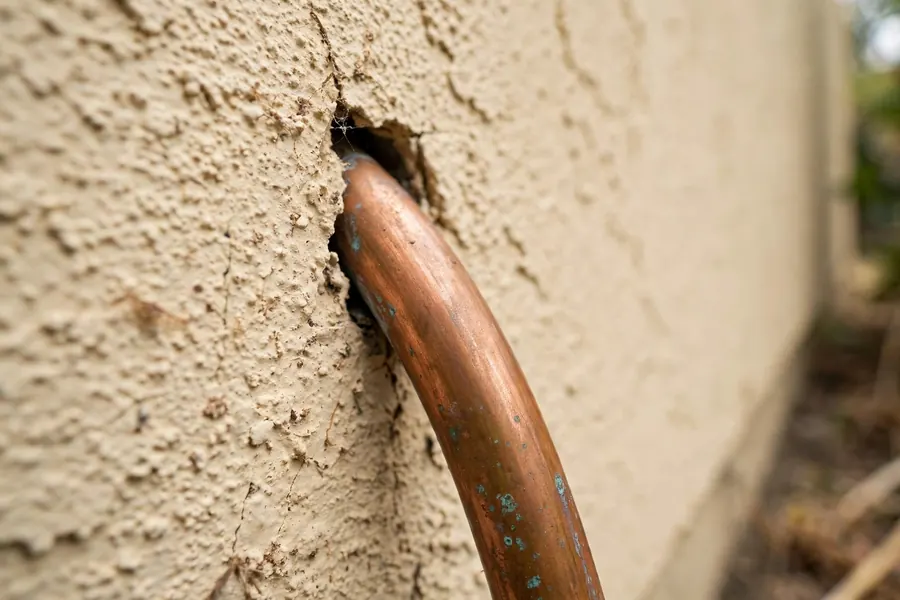
Foundation cracks and sill-plate junctions. Pipe and utility penetrations — plumbing, electrical, cable, gas, HVAC lines. Dryer vents with broken damper flaps. Brick weep holes left unscreened.
Roofline & upper structure
Soffit and fascia gaps, gable and ridge vents, roof returns, dormer junctions, roof plumbing stacks, uncapped chimneys. Tree branches touching the roof get trimmed back at least 3 feet — they're rodent highways.
Doors & garage
Gaps under exterior doors wider than 1/4 inch. Garage door seals — if you see daylight at the corners, that's an entry. Worn weatherstripping is the single most common garage entry we find.
Interior pathways
Under and behind kitchen cabinets, pipes under sinks and water heaters, floor-to-wall junctions, closet floor corners. Once inside, rodents travel wall voids and pipe chases like hallways.
The numbers that matter
The 1/4-Inch Rule: How Small a Gap Actually Matters
Rats need only 1/2 inch. So "sealed" means every opening down to 1/4 inch, everywhere on the building.
Where the gaps hide
Under exterior doors, around pipe and cable penetrations, where siding meets foundation, at roofline and fascia gaps, around unscreened vents, and in garage door weatherstripping. Gaps above ground matter just as much — roof rats arrive from above.
The caulk-and-foam trap
The most common DIY failure: filling holes with expanding foam or caulk. Rats and mice chew through both, plus plastic and wood, without effort. Those materials work only as backing or filler — the barrier itself must be metal.
Per the UC IPM spec
Materials That Actually Stop Rats
These are the exact specifications from the University of California IPM program — not handyman improvisation.
-
Wire mesh on vents — 1/4-inch, 16–19 gauge
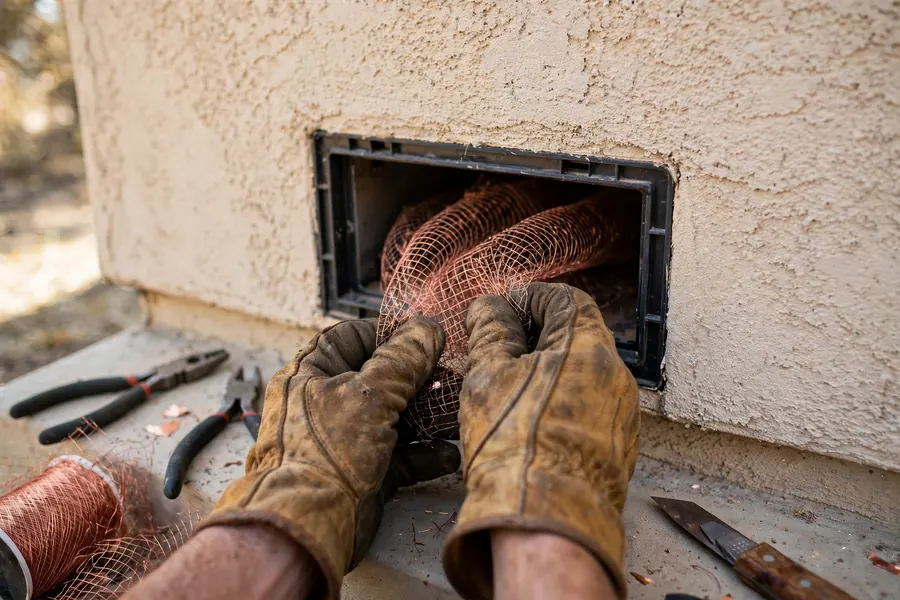
Attic and crawl-space vents sealed with 1/4-inch woven or welded wire mesh — never chicken wire, which rats shred in days. We use 16- to 19-gauge hardware cloth, mounted with hex-head screws, not staple guns. Staples pull out; screws don't. Vents wider than 2 inches get screened to the same standard.
-
Copper mesh for small holes — Stuf-Fit, never plain steel wool
Small gaps get packed with knitted copper mesh (Stuf-Fit) — it never rusts, unlike plain steel wool which corrodes and leaves rust stains in SLO's coastal air. Only 00-grade steel wool works at all, and even then it must be caulked over so rodents can't push it aside. Copper mesh gets the same treatment: pack it, then seal over it.
-
Door thresholds & brush sweeps — 26-gauge, 12 inches
Exterior doors get metal kick plates — 26-gauge, 12 inches tall, fitted within 1/4 inch of the door bottom. For sweeps, bristle beats rubber every time: rodents chew straight through rubber and plastic sweeps. Garage doors get brush-seal kits that close gaps up to about an inch and a quarter.
-
Sheet metal for roof & flashing — 24-gauge patches
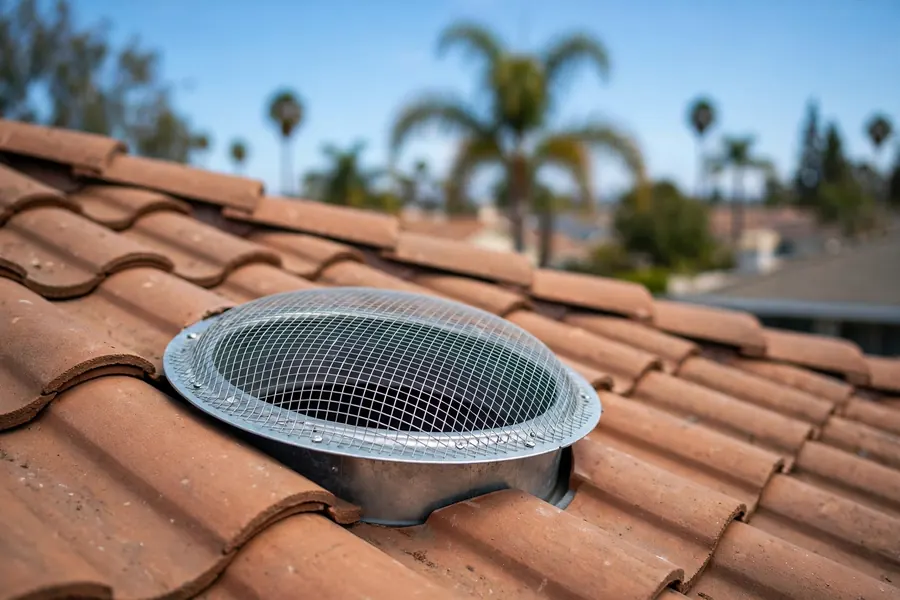
Broken roofing, damaged flashing, and gnawed edges repaired with 24-gauge sheet metal. Plus the details people miss: chimney spark arresters, and screened vent pipes — rats use both as entries. Attic, crawl-space, ridge, and gable vents all get 1/8- to 1/4-inch hardware cloth.
Materials compared: what we use and why
| Material | Best for | Lifespan | Notes |
|---|---|---|---|
| Copper mesh (Stuf-Fit) | Small holes & gaps ~2″ or less | Decades — never rusts | Pack tight, caulk over so it can't be pushed aside |
| 1/4″ hardware cloth, 16–19 ga | Vents, larger openings | 10+ years galvanized | Hex-head screws only — never staples or chicken wire |
| 26-gauge kick plates (12″) | Door bottoms | 10+ years | Fit within 1/4″ of door bottom |
| Bristle brush sweeps | Doors & garage doors | 5–8 years | Bristles beat rubber — rodents chew rubber through |
| 24-gauge sheet metal | Roof, flashing, gnawed edges | 15+ years | For patches and roofline repairs |
| Polyurethane caulk | Sealant over mesh only | 5–7 years | Never alone — always backing metal |
Save your money
What Fails: The Three Fixes That Don't Work
We get called to redo these every month. Each one looks sealed — until the rodents prove otherwise.
1. Spray foam alone
The number-one DIY mistake. Mice and rats chew straight through expanding foam — even the pest-formulated kind admits a determined rodent can still get through. Foam works only as a neat finish over metal, never as the barrier itself.
2. Steel wool with no caulk
Plain steel wool rusts in coastal air, stains your siding, and rodents work their way between the wool and the edges of the opening. It only works when caulked in place — and copper mesh does the same job without rusting.
3. Caulk or wood putty alone
Chewed through overnight. Caulk, wood filler, and plastic are fillers, not barriers. And one directional mistake to avoid: sealing interior gaps while exterior entries stay open just traps the problem where you sleep. Exclusion starts from the outside in.
Local knowledge
Where SLO Rats Actually Get In
Exclusion is local work. These are the entries we seal most often on San Luis Obispo homes.
Roofline & tile-roof gaps
Roof rats arrive from above, so the roofline is the front door. Aged fascia gaps on downtown's century homes, and the natural gaps in tile roofs on Laguna Lake-era tracts — rats travel tile courses like roads.
Attic & crawl-space vents
Original unscreened vents on older homes, and deteriorated screens on newer ones. Crawl-space vents are the ground-floor equivalent — Norway rat territory.
Garage doors & pipe chases
Worn garage weatherstripping with daylight underneath, plus pipe chases and utility penetrations running wall voids from garage to attic — interior highways for mice.
Foundation cracks & additions
Cracks in older foundations, and the gaps where additions, decks, and porch roofs meet the original house — every remodel line is a seam worth inspecting.
The complete job
The Pro 6-Step Exclusion Process
The most common exclusion failure isn't bad materials — it's bad sequencing. Seal a house with rodents still inside and you've locked the problem in. Every job we do follows the same six steps, in order.
-
1. Full inspection, ground to roofline
Exterior walk-around top to bottom, then attic and crawl-space. Every vent, pipe, chase, and penetration gets checked and photographed. Species confirmed — mice and rats get different trap strategies.
-
2. Prioritize the entries
Active entries (droppings, rub marks, gnawing) get sealed first in the plan; potential entries get ranked by size and location. Roofline entries jump the queue on tile-roof homes — that's where roof rats come in.
-
4. Select materials per opening
Copper mesh for small gaps, 1/4-inch hardware cloth for vents, sheet metal for roofline, brush sweeps for doors. Each opening gets the material that fits — not one product for everything.
-
5. Install & verify
Every entry sealed to the 1/4-inch standard with rodent-proof materials, hex screws — never staples. Then we re-inspect: if a pencil fits, it isn't done.
-
6. Monitor until silence
Traps stay on high-activity areas and get checked until activity stops completely. Then cleanup, and scheduled follow-ups to confirm the seals hold.
Straight numbers
What Exclusion Costs in SLO
Exclusion runs $500–$3,000+ in California depending on home size and entry count. Some companies bill $7–$10 per linear foot against roughly $1 in material cost — so compare line items, not headline prices. Our rodent exclusion cost guide breaks down what drives the price and what a proper quote should include.
What drives the price
Number of entry points, roofline complexity (tile roofs take longer), attic and crawl-space access, and whether trapping and cleanup are bundled in. A simple ranch with a dozen ground-level entries costs far less than a two-story with tile-roof gaps.
Red flag quotes
Watch for quotes that cover only trapping with no exclusion, no follow-ups, and no written warranty. And the local scam pattern: a no-cost "inspection" that turns into a $10,000 attic-contamination demand on the spot. Get a second licensed opinion before signing anything like that.
Good to know
Exclusion Questions, Answered
A young mouse fits through a 1/4-inch hole; an adult slips under a 1/4-inch-tall gap. Rats need only 1/2 inch. That's why exclusion sealing targets every opening down to 1/4 inch — smaller gaps than most people imagine.
UC IPM specifies: seal vents with 1/4-inch woven/welded wire mesh (never chicken wire), repair screens with 14- or 16-gauge 1/2-inch galvanized or rustproof wire mesh, plug small holes with steel wool or copper mesh, fit exterior doors with metal or heavy rubber thresholds, and repair broken roofing and flashing with sheet metal.
Galvanized mesh, sheet metal, and copper mesh repairs last for years — UC IPM calls exclusion the most successful and permanent form of house mouse control. The seals need occasional re-checks as buildings settle and weather wears caulking, but the rodent-proof materials themselves don't fail.
That's why exclusion comes after removal, not instead of it. We trap out the active population first, verify activity is gone, then seal. Sealing with rodents still inside is a mistake no specialist makes.
For gaps above the 1/4-inch threshold, no. Rats and mice chew through plastic, foam, wood, and caulk alone — those materials only work as filler alongside metal. Permanent seals need wire mesh, sheet metal, steel wool, or copper mesh.
Yes — a 1/4-inch standard stops both. A mouse fits through smaller openings than a rat, so sealing to the mouse spec automatically covers rats too.
Typically $500–$3,000+ depending on home size and how many entries need sealing. Tile-roof homes and two-stories run higher because roofline work takes longer. Compare line items — inspection, trapping, materials, follow-ups, warranty — not just the headline number.
Because rodents chew straight through it — even the pest-formulated foam admits a determined rodent can get through. Foam is fine as a neat finish over metal, but the barrier itself must be wire mesh, sheet metal, or copper mesh.
Seal It Once. Keep Them Out for Good.
An exclusion inspection finds every entry point a rat or mouse is using — then we close them all with materials that last. Call the crew today — one thorough visit is all it usually takes.
(805) 475-0516