Honest pricing guide
How Much Does Rodent Exclusion Cost in San Luis Obispo?
The honest answer: it depends — but “it depends” should come with ranges and reasons, not a shrug. Rodent exclusion (sealing every entry so they can't get back in) is skilled structural work, and its cost tracks five factors you can actually evaluate. Here's what drives the price, the ranges SLO homeowners typically see, and how to compare quotes without getting played.
- Five factors that set the price
- Honest ranges, not flat mystery numbers
- How to compare quotes
The factors
The Five Factors That Set the Price
Direct answer: home size and stories, number of entries, attic and crawl-space condition, contamination level, and roof complexity. Two identical floor plans can price very differently on entries alone.
Home size and stories
More linear feet of foundation, more eaves, more vents — a two-story home has roughly twice the roofline of a ranch. Size sets the baseline.
Entry count
A 1979 tract home with twelve gaps prices differently from a 1920s character home with forty. The inspection inventory — every gap over 1/4 inch — is what the quote is built on.
Attic and crawl-space condition
Clean, accessible spaces are fast to work in. Blown insulation hiding everything, low clearances, and moisture slow the job and raise the range.
Contamination
Droppings cleanup, disinfection, and insulation replacement are separate scope from sealing — CDC-protocol work with its own range. Our attic cleanup service details it.
Roof complexity
Tile roofs, multiple gables, and heavy eave detail take longer to seal properly than a simple composition roof. Complexity is labor, and exclusion is mostly labor.
The ranges
Typical Ranges SLO Homeowners See
Direct answer: minor sealing on a small home runs in the low hundreds; full-home exclusion on an average SLO house typically lands from the high hundreds into the low thousands; attic remediation adds a further low-thousands range. These are ranges, not quotes — your inspection inventory decides.
Minor sealing
A handful of entries on an accessible home: low-hundreds range. The quick jobs — door sweeps, a few vent screens, some pipe-chase sealing. SLO's housing stock tells the story: median build year is 1979, but that's an average of two very different jobs. An Old Town character home means settlement cracks, original vents, and a raised foundation with a crawl space — more linear feet to seal, more ladder time. A Laguna Lake tract home is mostly garage-door gaps and tile-roof entries — faster, fewer surprises. Same service, different house, different range.
Full-home exclusion
Comprehensive sealing — every entry, full perimeter, all vents — on a typical single-family home: high-hundreds to low-thousands range, tracking the five factors above.
Plus attic remediation
Contaminated insulation removal, disinfection, and reinstallation: adds a low-thousands range on top of exclusion. Often the right call together — seal first, then remediate.
What exclusion is NOT
It's not a per-visit spray price and it's not comparable to a trapping-only quote. Anyone quoting exclusion without an entry inventory is guessing — politely decline.
The real numbers
Cost Breakdown: What Each Part Runs in California
Direct answer: inspection $0–$150, full-home exclusion $500–$3,000+, trapping if bundled $250–$600, attic cleanup $1,500–$8,000+. Here's how the pieces stack up — and what moves each one.
| Service | Typical range (CA) | What moves it |
|---|---|---|
| Inspection + entry inventory | $0–$150 | Often waived if you hire for the exclusion work |
| Minor sealing (handful of entries) | $200–$500 | Entry count, accessibility, ladder time |
| Full-home exclusion | $500–$3,000+ | Home size, entry count, roof complexity, tile vs. composition |
| Trapping program (if bundled) | $250–$600 | Population size; includes 2–4 follow-ups over ~30 days |
| Attic cleanup & remediation | $1,500–$8,000+ | Contamination level, insulation type, square footage |
| Per-linear-foot billing | $7–$10/ft | Some companies bill this way; materials run ~$1/ft — the rest is labor |
How the job types compare
Relative scale — bars show the top of each typical range, so you can see at a glance where the money goes.
Local angle
Why SLO Homes Land Where They Do on the Range
Direct answer: tile roofs, older housing stock, and creek corridors push SLO jobs toward the upper half of the range. Here's the local math.
Tile roofs = roofline labor
Clay and concrete tile — all over SLO from Laguna Lake tracts to hillside homes — can't just be caulked at the eave. Roof returns, ridge vents, and tile-to-wall junctions need fitted metal and mesh, on ladders, often on the roof itself. Roof rats arrive at the roofline first, so this is where the real sealing happens. Expect tile-roof homes to run $300–$800 more than the same house with composition shingles.
Old Town vs. tract: two different jobs
A 1920s character home downtown — settlement cracks, original vents, raised foundation with a crawl space — can carry 30–40 entries. A 1979 Laguna Lake tract home is mostly garage-door gaps and a few tile-roof entries: faster, fewer surprises. Same service, very different inventory, very different range. This is why flat prices are fiction.
Creek corridors raise the stakes
Homes near SLO Creek, Stenner Creek, or Prefumo Creek sit on green corridors rats travel. More pressure means more entries get found — and the job needs to be thorough, because the next wave is always coming. If you're near water or heavy vegetation, budget toward the upper half and don't skip the follow-up check. Our rodent control program covers scheduled verification for exactly these homes.
Materials vs. labor
The Materials Are Cheap — You're Paying for the Ladder Work
Direct answer: professional exclusion materials run roughly $1 per linear foot. When a quote says $7–$10 per foot, the other $6–$9 is inspection, ladder time, fitting, and warranty — and that's legitimate.
What the pros actually use
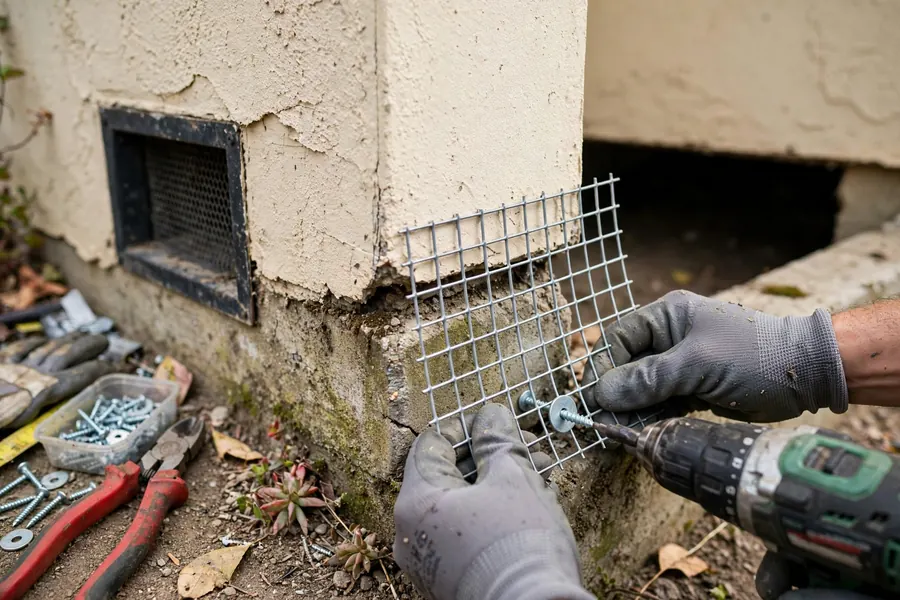
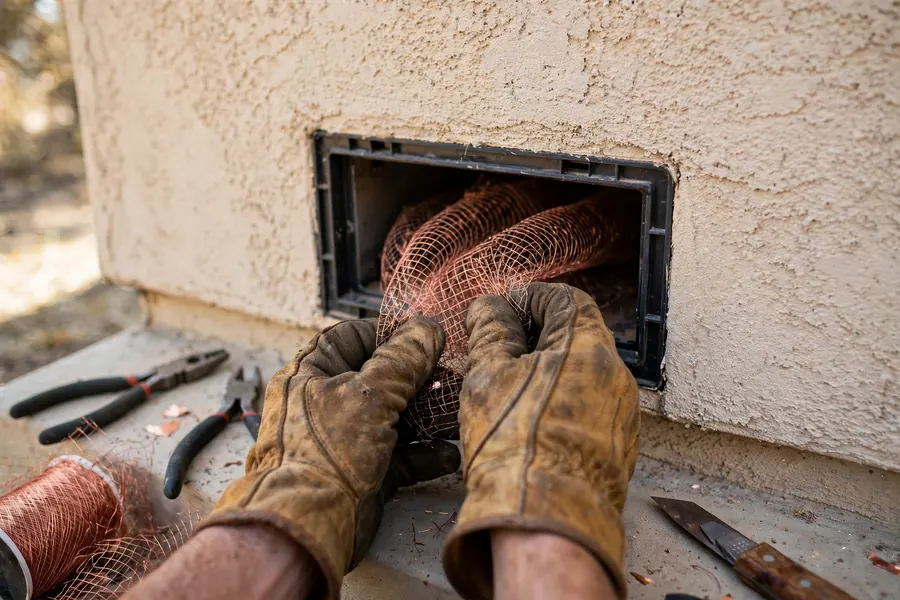
Copper mesh (Stuf-Fit) for small gaps — never rusts. 1/4-inch hardware cloth, 16–19 gauge, for vents — mounted with hex-head screws, never staples, never chicken wire (rats shred it in days). 26-gauge kick plates, 12 inches tall, on doors. Brush sweeps beat rubber — rodents chew rubber. None of this is exotic; it's just the right stuff, fitted right.
Why labor dominates
Finding forty entries takes longer than sealing them. The inspection — ground to roofline, attic, crawl space, every vent and pipe chase — is the skilled part. Then fitting metal to irregular gaps on a ladder, in a crawl space, or on a tile roof. A $500 materials bill on a $2,000 job is normal. The full exclusion process shows what the labor covers.
What fails (and costs you twice)
Spray foam alone is the #1 DIY mistake — mice chew straight through it, and even foam marketed as pest-blocking admits a determined rodent gets through. Steel wool without caulk rusts and gets pushed aside. Caulk alone gets chewed overnight. Cheap materials mean redoing the job — the most expensive quote is the one you pay twice.
Red flags
Quotes to Walk Away From
Direct answer: walk away from trapping-only quotes with no sealing, drive-by quotes with no attic look, and any no-cost inspection that turns into a five-figure attic demand.
The trapping-only quote
A quote that covers trapping with no exclusion, no follow-ups, and no warranty isn't a solution — it's a subscription. You'll pay $250–$600 now and the same again next fall. Exclusion is the permanent half; any quote missing it is incomplete by design.
The inspection-to-scare pipeline
California's known scam pattern: a no-cost inspection that "finds" catastrophic attic contamination and demands $10,000 on the spot. Real contamination exists — but the answer to a scary number is a second licensed opinion and a line-item scope, not a same-day signature. Compare line items, not fear.
The drive-by and the mystery "sealant"
Exclusion priced from the driveway, without entering the attic or crawl space, is fiction — the entries that matter are the ones you can't see from the curb. And if the quote says "sealant" without naming the material, ask: copper mesh? Hardware cloth? Or a tube of caulk a rat chews through by morning? Vague materials mean vague work.
DIY vs. pro
Can You DIY Exclusion to Save Money? An Honest Answer
Direct answer: yes, for the easy 20%. Pack copper mesh and caulk into pencil-width gaps, replace worn door sweeps, clear vegetation from the foundation — $50–$150 in materials handles that. The other 80% is why pros exist.
DIY handles
Ground-level gaps you can reach on foot. Door sweeps. Sealing around a hose bib or dryer vent with mesh and caulk. Trimming branches 3+ feet from the roof. These are real wins — do them this weekend regardless of who does the rest. (Skip the ultrasonic repellers — UC IPM says they aren't effective, and that money buys actual copper mesh.)
Call a pro when
Droppings in multiple areas. Scratching in walls at night. You've done the checklist and they keep coming back — that almost always means an entry you can't see, which means roofline, crawl space, or inside a wall. Also: if you're not sure whether it's rats or mice, get the identification right first — the sealing strategy differs.
Compare
How to Compare Quotes Without Getting Played
Direct answer: demand an entry inventory in writing, compare scope line by line — not bottom-line price — and beware quotes given without an attic and crawl-space look.
Demand the inventory
A real quote lists every entry found and what seals it: “14 foundation vents — 1/2-in galvanized mesh; 3 pipe chases — steel wool + flashing.” No inventory, no deal.
Compare scope, not price
A lower quote that skips the crawl space isn't cheaper — it's incomplete. Line up the scopes side by side; the cheapest complete scope wins.
Beware the drive-by quote
Exclusion priced from the driveway, without attic or crawl-space entry, is fiction. The entries that matter most are the ones you can't see from the curb.
Ask about materials
UC IPM spec: 1/2-inch galvanized mesh on vents (never chicken wire), steel wool plus flashing on chases, metal — not foam — on gnawed edges. If the quote says “sealant,” ask which one.
Value
Is Exclusion Worth It?
Direct answer: yes — it's the only permanent answer. Trapping without exclusion is a subscription to the same problem; exclusion ends the problem. UC IPM calls it the most successful and longest-lasting strategy for a reason.
Trapping is recurring
Trap a population without sealing entries and next fall's invasion restocks the house. You'll pay for trapping again — and again.
Exclusion is once
Done right with gnaw-proof materials, exclusion lasts years. The maintenance is a fall seal-check, not another infestation.
The damage math
Gnawed wiring, ruined insulation, contaminated pantries — one bad season costs more than most exclusion jobs. Prevention prices against damage, not against traps.
Our approach
Every rodent exclusion job starts with inspection, ends with an entry inventory you keep, and quotes ranges before work begins — never flat mystery numbers.
Good to know
Exclusion Cost Questions, Answered
Because entries vary enormously — twelve gaps vs. forty is a different job. Flat prices either overcharge simple homes or under-scope complex ones. Ranges after an entry inventory are the honest format.
Trapping removes today's population; exclusion prevents tomorrow's. Without sealing, reinfestation is a matter of when — usually the next October–November invasion. Exclusion is the permanent half of the job.
Typically no — insurers generally treat rodent prevention as maintenance, though sudden damage (like a chewed water line) may differ by policy. Check your policy and talk to your agent; we provide written findings for your records.
With galvanized and metal materials installed right, many years. Seals can wear — door sweeps, storm damage — which is why we recommend the annual fall check, or our rodent control program for scheduled verification.
Full-home exclusion typically runs $500–$3,000+ in California, driven by home size, entry count, and roof complexity. Minor sealing lands $200–$500; inspection alone is $0–$150 (often waived if you hire for the work). Attic cleanup, when needed, adds $1,500–$8,000+. These are ranges — your entry inventory decides the number.
It's a way to price the perimeter: $7–$10 per linear foot is common. Materials run roughly $1/ft — the rest is inspection, ladder work, fitting, and warranty. Per-foot billing is fine as long as the quote lists what's included per foot; compare it against lump-sum quotes by scope, not just the bottom line.
For ground-level gaps, yes — $50–$150 in copper mesh, caulk, and door sweeps handles the easy 20%. But roofline work, crawl spaces, and entries you can't find are pro territory. The honest rule: if you've done the visible checklist and they keep coming back, you're missing an entry — call a pro before spending more on materials.
Line items, not a single number: the entry inventory (every gap found, with location), the material per entry (copper mesh, 1/4-inch hardware cloth, kick plates — named, not "sealant"), trapping/follow-up scope if bundled, and warranty terms in writing. No inventory, no attic look, no deal.
Get a Real Number, Not a Guess.
Inspection first, entry inventory in writing, ranges before work begins. Call now or book an inspection.
(805) 475-0516SLO Rodent Control — inspection-first rodent control in San Luis Obispo, CA.